
Learning the German accusative case (Akkusativ) is often one of the first major milestones for English speakers learning German. While English has largely dropped its case system, German uses cases to signal the exact function of each noun in a sentence.
Here is a clear guide to understanding, recognizing, and mastering the German accusative case.
1. What is the Accusative Case?
In simple terms, the accusative case is used for the direct object of a sentence.
- The subject (Nominative case) performs the action.
- The direct object (Accusative case) receives the action directly.
The English Comparison
English used to have distinct forms for cases, but today you only see remnants of the accusative in pronouns:
- “He saw him.” (He is the subject/nominative; him is the direct object/accusative.)
- “They helped them.” (They = nominative; them = accusative.)
In German, this distinction applies not just to pronouns, but also to articles (a, the) and adjectives.
2. Changes in Articles and Pronouns
The best news about the German accusative case is that only masculine nouns change. Feminine, neuter, and plural forms remain identical to their nominative forms.
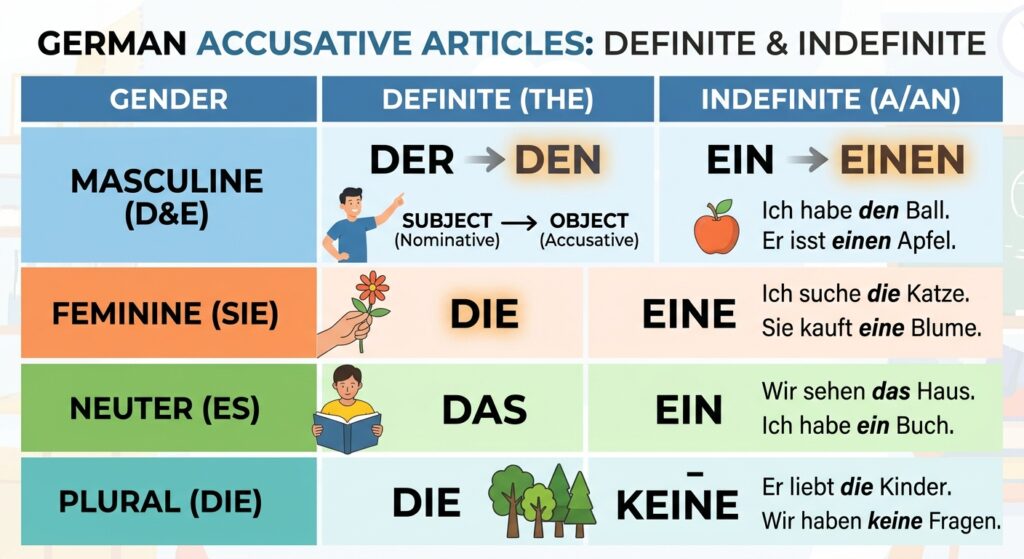
Definite Articles (“The”)
| Gender | Nominative | Accusative | Change? |
|---|---|---|---|
| Masculine | der Mann | den Mann | der → den |
| Feminine | die Frau | die Frau | No change |
| Neuter | das Kind | das Kind | No change |
| Plural | die Kinder | die Kinder | No change |
Indefinite Articles (“A / An”)
| Gender | Nominative | Accusative | Change? |
|---|---|---|---|
| Masculine | ein Hund | einen Hund | ein → einen |
| Feminine | eine Katze | eine Katze | No change |
| Neuter | ein Buch | ein Buch | No change |
Pro Tip: Keep an eye out for the ending -en on masculine forms in the accusative (
den,einen,meinen,keinen).
Personal Pronouns
| English | Nominative | Accusative |
|---|---|---|
| I / me | ich | mich |
| you / you (sing.) | du | dich |
| he / him | er | ihn |
| she / her | sie | sie |
| it / it | es | es |
| we / us | wir | uns |
| you / you (plural) | ihr | euch |
| they / them | sie | sie |
| You / You (formal) | Sie | Sie |
3. When to Use the Accusative Case
There are three main triggers for the accusative case:
A. Transitive Verbs (Direct Objects)
Most verbs that require an object take the accusative case.
- Ich habe einen Hund. (I have a dog.) — Hund is masculine.
- Er kauft den Tisch. (He is buying the table.) — Tisch is masculine.
- Wir sehen die Frau. (We see the woman.) — Frau is feminine (no visible change).
Watch Out: The verb sein (to be) does not take an accusative object. It takes a predicate nominative.
- Das ist ein Mann. (Not einen Mann).
B. Accusative Prepositions
Certain prepositions always trigger the accusative case, regardless of the verb or context. A common mnemonic to remember them is DOGFU:
- Durch (through)
- Ohne (without)
- Gegen (against / towards)
- Für (for)
- Um (around / at [time])
Examples:
- Das Geschenk ist für den Vater. (The gift is for the father.)
- Er geht durch den Park. (He walks through the park.)
- Sie macht das ohne ihren Bruder. (She does that without her brother.)
C. Two-Way Prepositions with Movement / Change of Location
Prepositions such as in, an, auf, über, unter, vor, hinter, neben, and zwischen take either accusative or dative:
- Accusative: Indicates movement from one place to another (answering Wohin? / Where to?).
- Dative: Indicates location/position without movement to a new location (answering Wo? / Where at?).
Example Comparison:
- Ich lege das Buch auf den Tisch. (I put the book onto the table.) → Accusative (movement/change of location).
- Das Buch liegt auf dem Tisch. (The book is lying on the table.) → Dative (stationary location).
4. Key Strategies for English Learners
- Spot the Masculine Noun First: Since only masculine words change in the accusative (
der→den), train yourself to pay immediate attention when using masculine nouns. - Memorize Noun Genders with Articles: Don’t just learn Stuhl (chair); learn der Stuhl. Knowing the gender makes choosing between der and den effortless.
- Learn the “DOGFU” Prepositions as a Unit: Commit durch, ohne, gegen, für, um to memory so you automatically use the accusative after them.
- Ask “Who or What is Receiving the Action?”:
- Subject (Nominative): Who is doing it?
- Direct Object (Accusative): Who/what is receiving it directly?
Take the Accusative quiz
Mini book for Accusative training
Video
Comments